When residents ask, “why are solar street lights not turning on at night,” the answer is rarely limited to one failed component. A dark road may reveal weak sunlight, battery ageing, a dirty panel, or an incorrectly configured controller.
Solar lighting engineer Dr. Priya Nair explains, “Night-time failure usually begins with a daytime energy problem, not the lamp itself.” This practical observation matters because the light depends on a complete daily cycle. The panel must collect energy, the battery must store it, and the controller must release it after sunset. One weak link can leave the entire fixture silent.
Sometimes, the cause is obvious. Dust may cover the panel like a thin grey blanket. A nearby tree may cast afternoon shade. In other cases, the fault hides inside the battery compartment, where corrosion or loose wiring interrupts power. A faulty photocell can also misread darkness. So can a timer with the wrong settings.
The investigation should begin with evidence, not guesses. Check the panel surface, battery voltage, controller indicators, cable connections, and nighttime load. Weather history also deserves attention. Several cloudy days can reduce stored energy sharply.
Small details matter.
This guide examines the ten most common reasons solar street lights remain off at night. It also separates temporary low-power conditions from genuine equipment failures. Some explanations may overlap, and field conditions are never perfectly predictable. That is worth acknowledging. A replacement battery may solve one installation, yet fail to address shading or poor system sizing. Reliable troubleshooting requires careful inspection, measured testing, and realistic expectations about local sunlight.
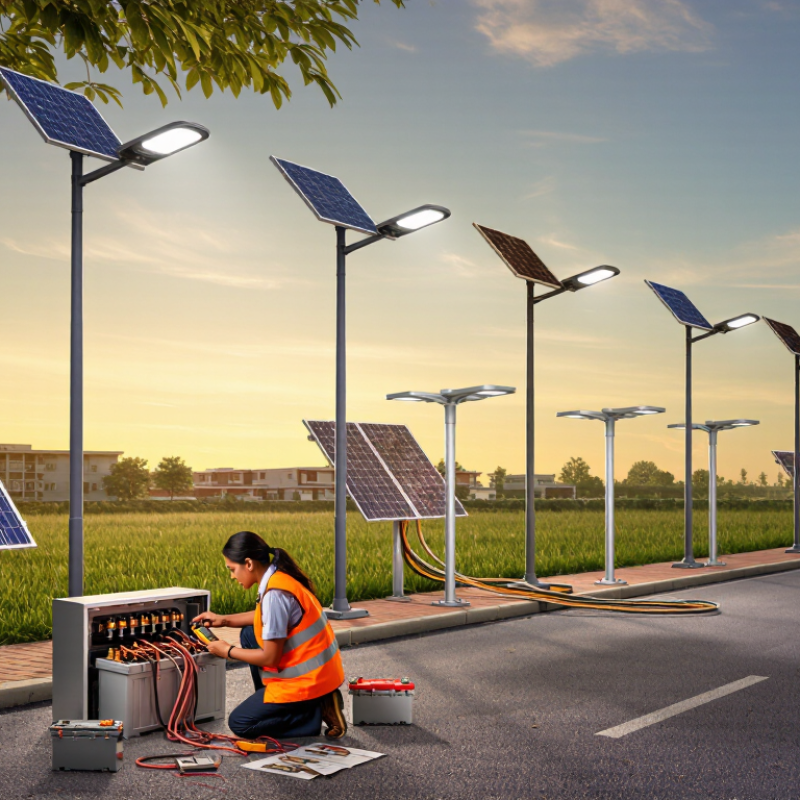
Solar Input Problems: Shading, Dirt, and 15–23% PV Module Efficiency
A solar street light can remain dark even when its battery is healthy. In field inspections, the cause often begins above the pole. PV modules rated at 15–23% efficiency convert only part of sunlight into electricity. This rating comes from controlled laboratory conditions, not shaded streets or winter clouds. Real output falls when a branch covers even one cell. Small shadows matter.
Dirt creates a quieter loss.
Dust, bird droppings, salt, and pollen form a thin film across the glass. The module may still look functional, but less light reaches the cells. A weekly visual check can reveal heavy buildup, while cleaning intervals should match local dust and rainfall. Use clean water and a soft brush. Avoid scratching the surface. I have seen maintenance teams blame the controller before checking a brown leaf covering one corner.
Assess shading in the morning, at noon, and late afternoon. Do not inspect only during installation. Nearby buildings can cast seasonal shadows that a quick survey misses.
Record charging voltage and current under clear conditions, then compare readings after cleaning. Do not trust efficiency labels alone.
Panel angle, orientation, temperature, wiring losses, and clouds also reduce harvested energy. Sometimes, the design looks acceptable on paper but performs poorly on site. That lesson deserves documentation, not excuses.
Battery and Controller Faults: 70–80% Depth-of-Discharge Limits
Top 10 Reasons Why Solar Street Lights Stay Off at Night? Battery and Controller Faults: 70–80% Depth-of-Discharge Limits
A dark solar street light often begins with an incomplete daytime charge. Dust, shade, weak sunlight, loose terminals, and undersized panels reduce stored energy. The controller may then protect the battery by disconnecting the lamp before midnight. Many systems use a 70–80% depth-of-discharge limit, leaving 20–30% reserve. This protects battery life, but it can also create confusing shutdowns.
The U.S. Department of Energy’s Energy Storage Grand Challenge Roadmap identifies battery management, temperature control, and monitoring as core reliability functions. A failed voltage sensor can falsely report a full battery or trigger an early low-voltage cut-off. Corroded connectors create resistance and heat. A damaged charge controller may stop charging entirely. Lithium batteries also need accurate protection settings. Lead-acid batteries need more conservative charging and deeper recovery checks.
NREL’s 2024 Annual Technology Baseline uses about 85% round-trip efficiency for lithium-ion storage systems, showing that stored energy is never fully delivered. Real street conditions are harsher. Cold nights, aging cells, and cloudy weather reduce available capacity further. Technicians should measure panel voltage, charging current, resting battery voltage, and controller fault codes. A simple visual inspection is not enough. One overlooked cable can imitate a failed battery. The 70–80% limit is sensible, but not universally correct. Configuration errors still happen.
Photocell and Timer Errors: Dusk Detection, Modes, and Reset Checks
Top 10 Reasons Why Solar Street Lights Stay Off at Night?
Photocell and timer errors often cause several of the ten common failures. A dusty sensor may read daytime conditions after sunset. Nearby walls, trees, or bright security lamps can also confuse dusk detection. Check the sensor at dusk, not only during full darkness. Covering it briefly can confirm whether the light responds, but this test is imperfect.
Timer settings create different problems. The unit may use a three-hour, six-hour, or dawn-to-dusk mode. A recently changed setting can leave the lamp disabled overnight. Some controllers also retain an incorrect start time after battery replacement. Inspect the mode, duration, and clock setting when available. A manual switch may be set to Off without obvious markings.
Tips: Clean the photocell with a dry, soft cloth. Remove temporary shade around the sensor. Confirm the panel receives daylight, then let the battery charge fully. At night, select the normal dusk mode and observe the lamp for several minutes. If it remains off, turn the system off, wait about one minute, and restart it. This reset can clear a temporary controller fault. I have seen technicians replace batteries too early because they skipped this check. Still, resets cannot repair damaged wiring, weak batteries, or a failed sensor. Record the mode and test result before changing another setting.
How to read this chart:
Photocell contamination, incorrect timer settings, battery undercharging, and loose wiring are common first checks when solar street lights remain off after sunset. Confirm dusk-detection mode, inspect the sensor, verify timer schedules, and reset the controller before replacing components.
The percentages represent a practical, non-brand-specific diagnostic reference and are intended for troubleshooting prioritization.
Wiring and Protection Failures: IP65 Enclosures and Voltage-Drop Testing
A dark solar street light often has a wiring problem, not a failed panel. Loose terminals, reversed polarity, and damaged insulation can interrupt power after sunset. I once blamed the battery too quickly. The real fault was a slightly pulled cable inside the pole.
An IP65 enclosure protects against dust and low-pressure water jets. It does not guarantee safety after flooding, condensation, or careless cable entry. Inspect the gasket, gland, and drain path for cracks or gaps. Look closely. Moisture may leave green corrosion on terminals before the light stops working. Tighten connections to the specified torque, but avoid crushing thin conductors.
Voltage-drop testing
should happen under nighttime load, not only with a disconnected meter. Measure voltage at the battery, controller, and lamp terminals while the light operates. A large difference indicates undersized cable, excessive length, or a high-resistance connection. Compare readings with the equipment’s working range. A small reading error can mislead the diagnosis. I have seen technicians test at the cabinet and miss a warm connector halfway up the pole. That mistake is easy to repeat. Check the negative conductor too. It can fail quietly. When protection devices trip repeatedly, replace neither fuse nor controller blindly; find the short circuit, water path, or crushed cable first.
LED and Installation Issues: 100,000-Hour Ratings, Heat, and Winter Runtime
A solar street light may stay dark because its LED rating looks better on paper than in service.
A “100,000-hour” claim usually describes projected lumen maintenance, not guaranteed operation. DOE’s Solid-State Lighting reports explain that L70 ratings often depend on laboratory testing and modeled depreciation. IES LM-80 and TM-21 methods measure and extrapolate LED performance, but they do not certify the battery, driver, wiring, or solar panel.
Heat is often the quiet failure.
A poorly ventilated housing can trap heat around the LED board and driver. Higher junction temperatures accelerate lumen loss and may trigger thermal protection. Dust-covered panels also reduce charging, especially when a small shadow crosses one cell. During site inspections, I have found loose connectors, reversed polarity, and water inside cable glands. These details are not glamorous, but they switch off real lamps.
Winter exposes weak design choices.
NREL’s PVWatts documentation shows that solar production changes with season, tilt, shading, and local weather. Battery capacity also falls in cold conditions; a battery rated at 25°C may deliver less energy near freezing. Short December days can therefore leave insufficient power after a cloudy afternoon. The lamp may work perfectly in summer. That is the uncomfortable part. Installers should verify measured charging current, nighttime load, battery temperature, and controller settings, rather than trusting a 100,000-hour LED label. A 2023 field report from IEA PVPS also highlights the effect of snow, soiling, and seasonal irradiance on photovoltaic output.
Conclusion
When asking “why are solar street lights not turning on at night,” the cause is often related to insufficient solar input, battery limitations, or control settings. Shading, dust, and the typical 15–23% efficiency of photovoltaic modules can reduce daytime charging. Batteries may also fail to provide power when they are aged, damaged, or discharged beyond their recommended 70–80% depth-of-discharge limit. In addition, incorrect photocell positioning, timer settings, operating modes, or a controller that needs resetting can prevent automatic dusk activation.
Electrical and installation problems should also be inspected. Loose wiring, voltage drops, damaged protection components, or moisture entering an enclosure rated around IP65 may interrupt power delivery. The LED fixture itself can be affected by overheating, poor connections, or installation faults, even though many LEDs are designed for service lives of up to 100,000 hours. In winter, shorter daylight hours and colder temperatures may further reduce runtime, making proper panel placement, battery sizing, testing, and routine cleaning essential.

